Auto Component Production and Rejection Tracking in the UAE
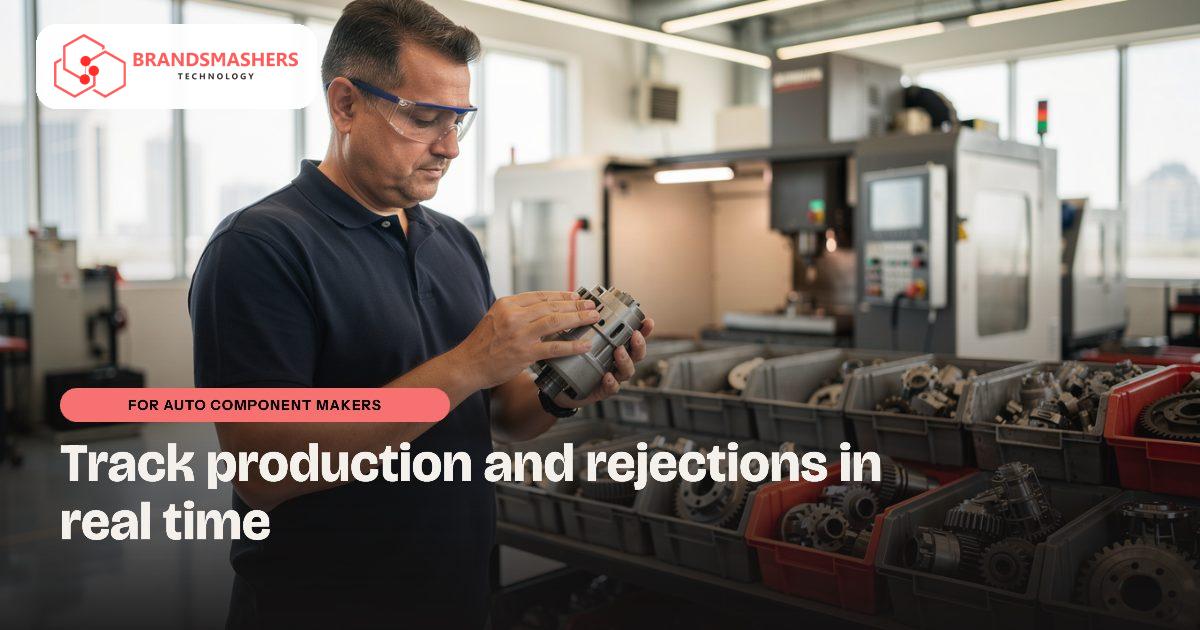
A shift supervisor writes rejection counts on a sheet. By the time the weekly review arrives, the same defect has run for three shifts on the same die. For auto component makers in Dubai, Sharjah or Abu Dhabi, this is what happens when production plans change by the hour, rejections are noted on paper, and nobody sees the pattern until a customer complains. Brandsmashers Tech, based in Bhopal, builds fast, AI-assisted custom software for gaps like this. Here is how we would approach it for an auto component maker.
01.Who this is for
This is for auto component makers and suppliers in Dubai, Sharjah or Abu Dhabi, often serving export and regional customers from an industrial area. The signs are easy to spot. Supervisors note rejections on paper in whatever language they are most at ease with, and nobody combines them until the review. The plan shifts during the day but the floor works from the morning printout. Dispatch paperwork is assembled by hand for each customer, and a recurring defect is only noticed when a buyer raises it.
02.Why rejections hide on paper
Most auto component makers do not lack effort. They lack one place where the facts live. So people fill the gap with calls, messages and memory, which works until volume grows or a key person is away. Off-the-shelf tools rarely fit because your process has its own steps and exceptions, and forcing it into a template brings the spreadsheets back.
03.What we build for the shop floor
We start with the workflow that hurts most. For this business that usually means a production plan versus actual view by line and shift, a quality and rejection log with defect codes and reasons, a dispatch tracker tied to customer schedules, and simple dashboards for the plant head, readable on a phone. AI-assisted development lets you see a working version early and refine it with your team. Where you already run accounts software, we connect to it rather than replace it. We keep screens simple, because a system nobody enters data into is worse than none.

04.Where AI helps, and where it stops
The AI layer is modest and useful: defect-trend alerts that flag a rising rejection pattern on a part, machine or shift so the quality team can look early. The alert points to the data; your quality engineers decide the cause and the action. If your data is thin at the start, we begin with clean capture and add intelligence as records grow.
05.Built for the UAE, not adapted to it
UAE manufacturers and component suppliers often serve export and regional customers, so dispatch records need clean, bilingual documentation and VAT-correct invoices. Screens work in Arabic or English for mixed-language shop floors. We build for industrial areas in Sharjah, Dubai and Abu Dhabi and scope to your lines, not to a generic template.
06.How a first version comes together
In a UAE component plant, a first version usually comes together around the shop floor's rejection sheet and the dispatch file.
- 01Over video calls and shared photos of your current sheets, we trace how a production plan becomes output, rejections and a dispatch.
- 02We agree a starting scope of plan versus actual and a rejection log with your own defect codes, in Arabic or English.
- 03Shift supervisors from mixed-language teams test it during real production, and we adjust screens until entry is quick for everyone.
- 04Dispatch tracking tied to customer schedules follows, with bilingual documentation and VAT-correct invoices.
- 05Defect-trend alerts are added once the log holds enough history, giving your quality engineers an earlier view while they keep the final call.
07.Questions buyers ask
- Can auto component production software in the UAE run in Arabic and English on the same shop floor?
- Yes. Screens work in Arabic or English, so each supervisor can choose the language they read fastest. The records underneath are the same, which means the plant head sees one combined view of output and rejections. This suits mixed-language shop floors where the old paper sheets were filled in several different ways.
- Will our export customers get proper dispatch documents?
- Dispatch records are built for clean, bilingual documentation, and invoices carry VAT correctly. Each dispatch is tied to the customer's schedule so the team can see what is due next. Where you already run accounts software, we connect to it rather than replacing it, so finance does not have to rekey dispatch details by hand.
- Can we start with a single line before rolling out to the whole plant?
- Yes, and we recommend it. Starting with one line lets supervisors get used to the screens while we fix anything that slows them down. Once the figures from that line are trusted, the same setup extends to the others. Scope follows the lines you actually run, not a generic template.
- What role does AI play in rejection tracking?
- It watches for rising rejection patterns on a part, machine or shift and alerts your quality team early. The alert points to the data behind it. Your quality engineers decide the cause and the action, and the system records what they decide. If history is thin at the start, we focus on clean capture first and add alerts later.
Next step: Tell us the one process that costs auto component makers the most time today, and we will sketch what a first version could look like for your team in Dubai. Contact Brandsmashers Tech
NEXT STEP
Need help with this?
KEEP READING