
OPD, IPD and Insurance Claims in One Place: A Lightweight HMS for Indian Nursing Homes
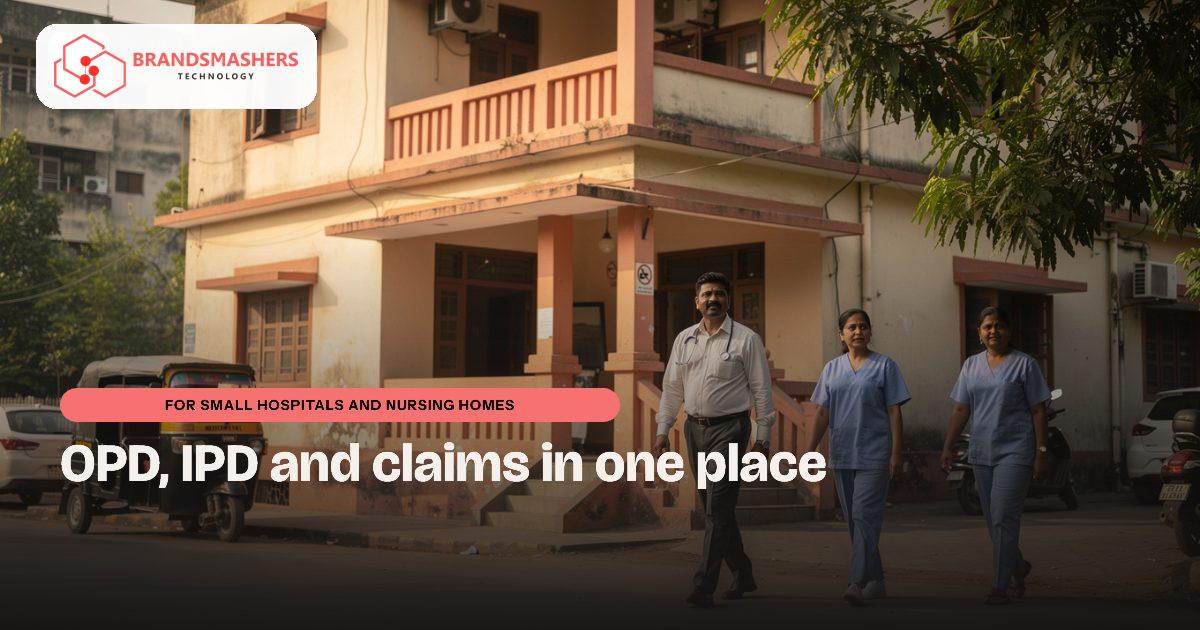
In a 20-50 bed hospital, the OPD desk, the ward, the billing counter and the insurance desk often run on four different tools, or on none. Every handover is a chance to lose a charge or a document. A lightweight HMS joins them without the weight and price of an enterprise suite.
01.Who this is for
This is for small hospitals and nursing homes in India, typically between a couple of dozen and a few dozen beds, that handle cash patients, insurance patients and TPA paperwork at the same time. You have outgrown registers when the OPD desk, the ward, billing and the insurance desk each keep their own records. Charges get missed between ward and billing, discharge files are assembled by hand while the family waits, and nobody can say which claims are still pending with which TPA.
02.Where the work breaks today
Nursing homes in cities like Bhopal, Indore and Gwalior juggle cash patients, insurance patients and TPA paperwork at once. When the final bill, discharge summary and claim documents are assembled by hand at discharge, delays follow, and unpaid claims become hard to chase because nobody tracks status in one place.
03.What we build
We build a lightweight HMS: OPD and IPD, billing, and TPA claim tracking. Every build is custom to how you actually work, so we start by watching your counter, ward or desk for a day and mapping the real flow, not an imagined one. Our AI-assisted process lets a small team build quickly, so you see a working version early and shape it with your staff instead of reading a long specification.

04.Where AI helps
The AI layer is deliberately practical. For this business that means: claim-document extraction that reads discharge summaries, bills and reports and pre-fills claim forms for staff to check. A person always reviews anything that matters, and the AI never takes the final decision. It is there to remove repetitive effort, not to replace your team’s judgement. We also keep the data yours: you own the system, the records and the code, and your WhatsApp numbers and templates stay under your control.
05.Fitting it to your clinic, your rules and your rupee budget
ABDM matters here: nationally about 5.33 lakh facilities were registered by 10 July 2026, yet only 2.72 lakh used ABDM-enabled software. Vendor blogs put custom builds for a 20-50 bed hospital around Rs 6-12 lakh, though another source quotes much higher, so the honest answer is to get a scoped quote. Certification and compliance work is separate effort. Check specifics with your adviser.
06.How a first version comes together
For a nursing home, the first version follows a patient from admission to discharge so every charge and document lands in one file.
- 01We spend time at the OPD desk, a ward station and the billing counter to see how charges, notes and claim papers move today.
- 02We agree the first version with you, usually OPD and IPD registration with billing, so charges are captured at the ward rather than at discharge.
- 03We build and test it with your nurses, billing clerk and insurance desk using real admissions, without touching certification work at this stage.
- 04We go live on one ward first, then add the rest of the hospital and TPA claim tracking once the ward team is using it daily.
- 05After the core is steady, we add claim-document extraction that pre-fills claim forms from discharge summaries and bills, which your insurance desk checks.
07.Questions buyers ask
- What does hospital management software for nursing homes in India need to cover?
- It needs OPD and IPD records, billing that captures charges as they happen and TPA claim tracking in one place. A lightweight HMS like this joins the desks a nursing home already has. We also keep ABDM in mind, so the records are structured in a way that suits digital health requirements.
- Can it track TPA claims after discharge?
- Yes. Each claim has a status, the documents attached to it and the person responsible for chasing it. Your insurance desk can see which claims are waiting, which were queried and which are settled, instead of relying on memory, emails and a stack of folders in the billing office.
- How does AI help with insurance paperwork?
- AI reads discharge summaries, bills and reports and pre-fills the claim form. Your staff then check every field before anything is submitted. It saves retyping the same details, but the decision to send a claim, and responsibility for its accuracy, stays with your team.
- Do we have to replace everything at once?
- No. We usually start with one ward and the billing counter, then add other areas once staff trust the system. Certification and compliance work is separate effort and we scope it honestly. Starting small lets your team learn the system without risking a full day of admissions and discharges.
Next step: Tell us how your team works today, and we will map a fixed-scope first version. We reply in English or Hindi, and we are happy to meet in Bhopal. Talk to Brandsmashers Tech
NEXT STEP
Need help with this?
KEEP READING
More from the blog.
- FOR POLYCLINICS
Retire the Appointment Register: Polyclinic Software That Fits Indian Clinics
READ ARTICLE - FOR DENTAL CLINIC CHAINS
Never Miss a Recall: Patient Records and Treatment Plans for Indian Dental Chains
READ ARTICLE - FOR POLYCLINICS
Appointments, Records and Billing in One System for UAE Polyclinics
READ ARTICLE