
Small Developers in India: Move Unit Inventory and Payment Schedules Out of Excel
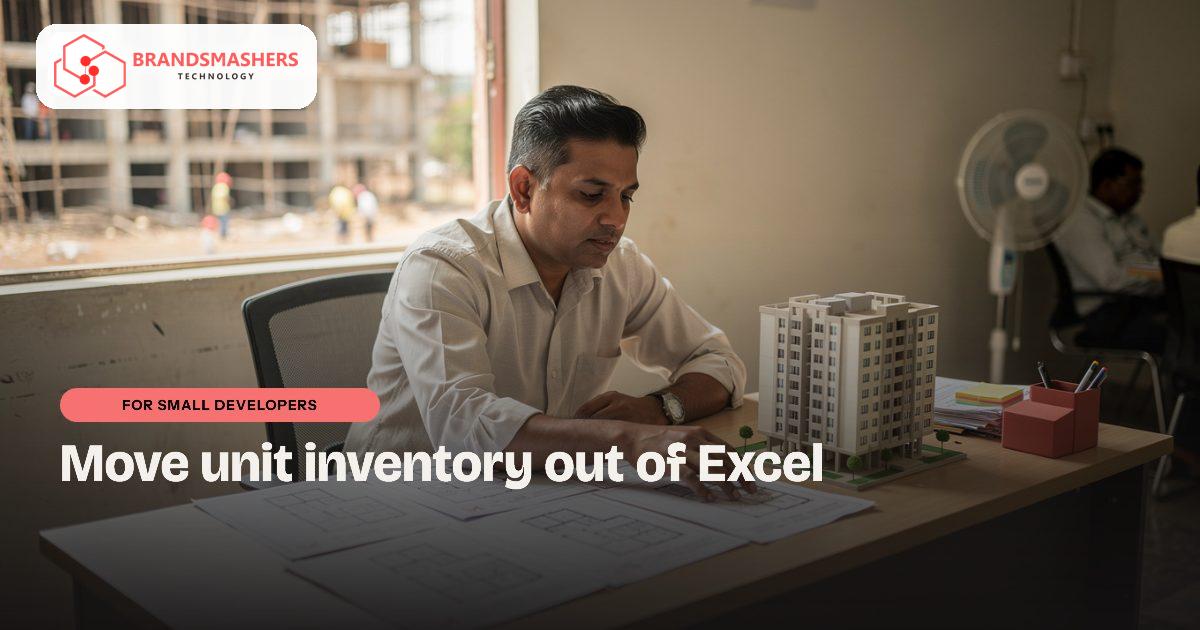
If you run a small real estate project in Bhopal, Indore or Nagpur, your most important numbers probably sit in Excel: which units are free, which are blocked, and who owes what and when. One wrong cell and a buyer is quoted a sold flat. Brandsmashers Tech builds fast, AI-assisted custom software that replaces that sheet with one system your whole team trusts.
01.Who this is for
This is for a small developer running one or two residential or commercial projects, usually with a compact sales desk, an accountant and a site office. The signs are easy to spot. Two executives quote the same flat on the same afternoon. The accountant keeps a private copy of the payment schedule because the shared one cannot be trusted. Demand letters are typed fresh each time a slab is cast, and the GST line is checked by whoever is free. Buyers call the site office to ask what they owe.
02.The problem today
Spreadsheets break quietly. A sales executive updates one copy, accounts update another, and the site office works from a third. Payment schedules tied to construction stages are the worst case, because every demand letter depends on the right date, the right amount and the right GST treatment being checked by a person under time pressure. Nobody notices the gap until a buyer disputes a figure or a collection slips a month.
03.What we build
We build a single unit inventory with live status, a booking flow that blocks a unit the moment it is reserved, demand letters generated from the payment schedule, and a payment tracker that shows what is due, received and overdue per buyer. Your accountant can still export to Tally. Because we start from BST Sales, our own running CRM, the lead side comes ready and we spend build time on your inventory rules and your payment plans.

04.What it costs you today
A mainstream real estate CRM in India costs roughly Rs 700 to Rs 3,000 or more per user per month, with calling and WhatsApp extra, and still may not model your inventory the way you sell. A system shaped around your own project can replace several tools at once.
05.Where AI helps and how we start
The AI add-on here is lead scoring and payment reminders. It is a helper, not a replacement for your people: staff still make the decisions, and the software removes repetitive typing and checking. We usually start from BST Sales, build a small first release you can use within weeks, and extend it as your team gives feedback. Pricing is fixed to scope after we understand your process, in rupees and with GST invoices.
In the first month the goal is simple: your team should be entering real small developers data into the new system, not into a test. We keep the first release narrow, covering unit inventory, bookings, demand letters and a payment tracker, so that people adopt it quickly and tell us what is missing.
06.How a first version comes together
For a developer, the first version is built around the unit list and the payment plan, because every other record depends on those two.
- 01We sit with your sales desk and accountant to trace how a unit moves from enquiry to blocked to booked, and how each construction stage turns into a demand letter.
- 02Together we agree a first version that covers live unit status, bookings and the payment tracker, and we leave anything nobody needs yet for later.
- 03We build on BST Sales, load your real inventory and buyer schedules, and test it with your sales executives and accountant before anyone relies on it.
- 04We go live on one project first, keep the Tally export working for your accountant, and fix what the team reports in their first round of use.
- 05Once the team uses the core every day, we switch on lead scoring and payment reminders, with your staff still approving what goes to buyers.
07.Questions buyers ask
- Can real estate developer software in India start from our existing Excel sheets?
- Yes. We take your current unit sheet and payment schedules as the starting point and map each column to the new system. Gaps and duplicates usually show up during that step, and we clear them with your team before go-live, so the first live data is cleaner than the sheet it replaces.
- Will our accountant have to stop using Tally?
- No. The system keeps an export to Tally, so your accountant continues working the way they do now. What changes is that demand letters, receipts and dues come from one shared record instead of several spreadsheets, which means fewer figures to re-enter or cross-check by hand at month end.
- Can we roll it out on one project before the others?
- Yes, and we recommend it. Starting with one project lets your sales desk and site office learn the flow on real bookings while the scope stays small. Once they are comfortable and the payment plans behave correctly, adding the next project is mostly a matter of loading its units and schedules.
- How do we get a price, and how are we billed?
- Tell us how your team sells and collects today, and we suggest a first release. Pricing is fixed to that scope once we understand your process, quoted in rupees, and invoiced with GST. Further features are scoped and priced the same way, so you always know what the next step involves.
Next step: Tell us how your team works today and we will suggest a first release. Talk to Brandsmashers Tech
NEXT STEP
Need help with this?
KEEP READING
More from the blog.
- FOR REAL ESTATE BROKERAGES

Real Estate Brokerage CRM in India: Stop Losing Leads Across Portals and WhatsApp
READ ARTICLE - FOR REAL ESTATE BROKERAGES

Dubai Brokerage CRM: Capture Every Portal and WhatsApp Lead in One Place
READ ARTICLE - FOR CHANNEL PARTNERS

Channel Partner Commission Tracker: One View Across Every Developer You Sell For
READ ARTICLE