Trading Company Software in India: Quote to GST Invoice Without Re-Typing
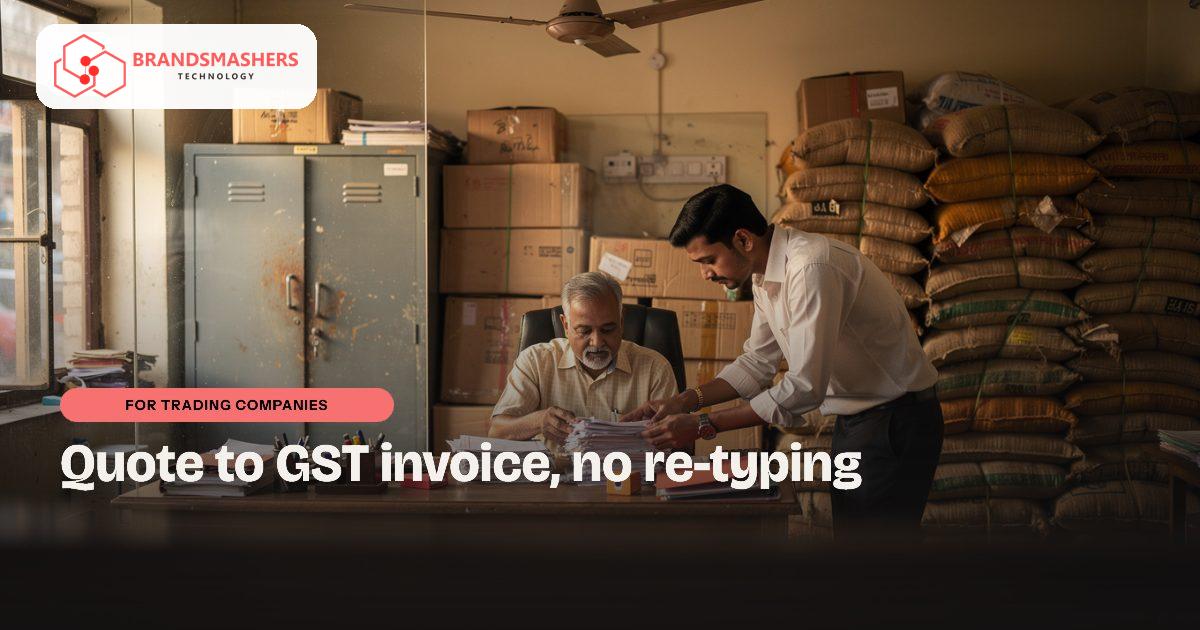
A customer asks for a revised quote on a container. Someone searches old emails for the supplier price, re-keys the lines into a template, and the invoice later disagrees with the quote. For trading companies in Mumbai, Surat or Indore, this is what happens when quotes live in email threads, shipments in spreadsheets, and VAT invoices are typed again by hand at the end. Brandsmashers Tech, based in Bhopal, builds fast, AI-assisted custom software for gaps like this. Here is how we would approach it for a trading company.
01.Who this is for
This is for Indian trading companies that buy from suppliers, hold or move stock by container or warehouse, and sell to many buyers on credit. You have outgrown spreadsheets when a revised quote means digging through old emails for the supplier price, when the invoice does not match what was quoted, and when the sales team phones the warehouse to ask what is actually in stock. Other signs include e-way bill details typed twice, units of measure mixed up between documents, and ledger questions only the accountant can answer.
02.The cost of re-typing the same trade data
Most trading companies do not lack effort. They lack one place where the facts live. So people fill the gap with calls, messages and memory, which works until volume grows or a key person is away. Off-the-shelf tools rarely fit because your process has its own steps and exceptions, and forcing it into a template brings the spreadsheets back.
03.What we build for a trading desk
We start with the workflow that hurts most. For this business that usually means a quote-to-invoice flow where one entry becomes the quote, order, delivery note and invoice, stock and shipment tracking by container, warehouse and customer, invoice output structured so it is ready for e-invoicing integration, and a customer and supplier ledger view for the sales team. AI-assisted development lets you see a working version early and refine it with your team. Where you already run accounts software, we connect to it rather than replace it.

04.Where AI helps, and where it stops
The AI layer is modest and useful: document extraction that reads supplier quotations, packing lists and bills of lading and fills the draft fields for a person to confirm. Extracted values are always shown next to the source document, and nothing posts until a team member approves it. If your data is thin at the start, we begin with clean capture and add intelligence as records grow.
05.Built for India, not adapted to it
Indian traders live with GST invoices, e-way bills and multiple units of measure. The flow is built around GST-structured output and sits beside Tally or Busy rather than replacing your accounts. Your accountant keeps final say on tax treatment. Price and scope are in rupees, and WhatsApp can carry quote approvals your buyers already send that way.
06.How a first version comes together
For a trading desk, the first version usually follows the path one enquiry takes from quote to GST invoice.
- 01We map how a quote is built today, which emails and sheets the sales team opens, and where the same lines get re-keyed.
- 02We agree a first version where one entry becomes the quote, order, delivery note and invoice, leaving other flows for later.
- 03Your sales and accounts staff test it on live enquiries, checking that units of measure and GST-structured output come out right.
- 04Stock and shipment tracking by container, warehouse and customer is added next, alongside the ledger view for the sales team.
- 05Document extraction for supplier quotations, packing lists and bills of lading comes last, with every value confirmed by a person.
07.Questions buyers ask
- Does trading company software in India replace Tally or Busy?
- No. The quote-to-invoice flow sits beside Tally or Busy rather than replacing your accounts. Your sales desk works in the new system, and the accounting side continues where your accountant is comfortable. This keeps the change small for the finance team while removing the re-typing that causes quotes and invoices to disagree.
- Can it cope with multiple units of measure and e-way bills?
- Yes, these are part of the brief for Indian traders. Items can be bought in one unit and sold in another, and the system keeps the conversion consistent from quote to invoice. E-way bill details are captured with the dispatch so they are not typed again. Your accountant keeps the final say on tax treatment.
- How accurate is the document extraction from supplier paperwork?
- It is a drafting aid, so a person always confirms it. The AI reads supplier quotations, packing lists and bills of lading and fills draft fields. Each extracted value is shown next to the source document, and nothing posts until a team member approves it. If a field looks wrong, your staff correct it before it reaches a quote or invoice.
- Can our buyers keep approving quotes on WhatsApp?
- Yes. Many buyers already send approvals that way, so WhatsApp can carry quote approvals into the system instead of leaving them in a chat. The approved quote then moves to order and invoice without anyone retyping the lines. Price and scope for the build are in rupees, and the first version is shaped around the flow that costs you most time.
Next step: Tell us the one process that costs trading companies the most time today, and we will sketch what a first version could look like for your team in Mumbai. Contact Brandsmashers Tech
NEXT STEP
Need help with this?
KEEP READING