
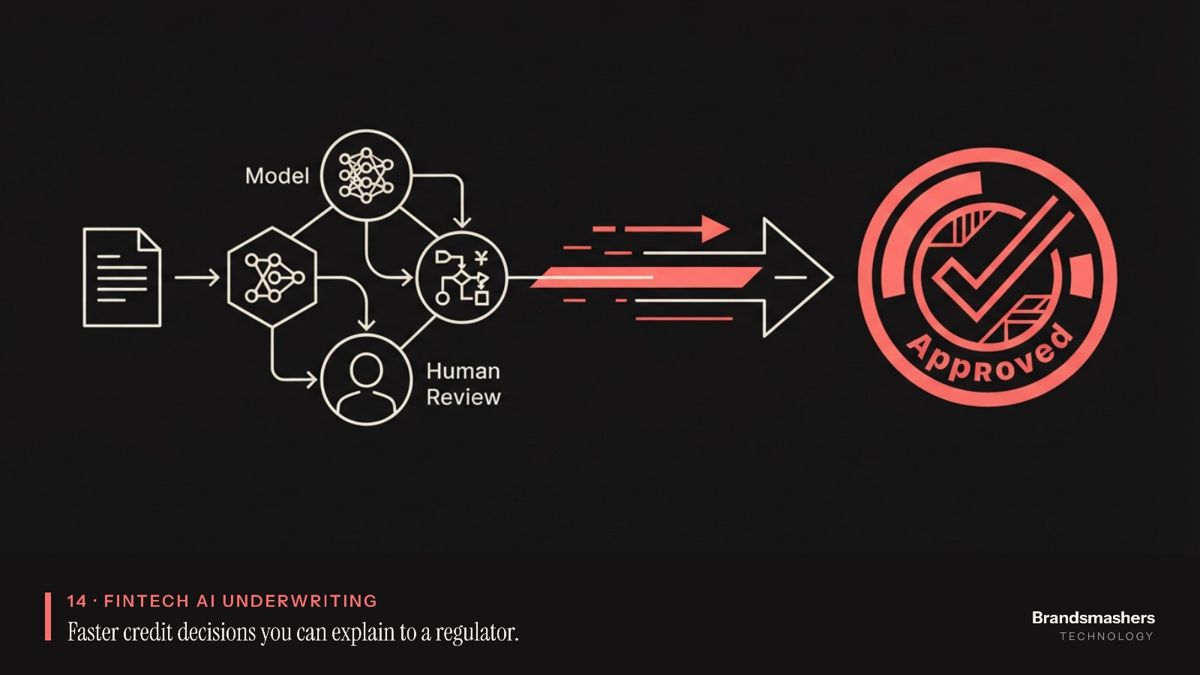
Faster credit decisions you can explain to a regulator.
Credit models, decision engines and data pipelines for lenders, built for fairness, auditability and speed.
- 48–72 HOURS
- TOP 3% ENGINEERS
- 100% REPLACEMENT
What we do.
Credit scoring models
using traditional and alternative data, validated on data the model has never seen.
Decision engines
that combine rules, models and manual review, so each application takes the right path.
Document and income verification automation,
reading statements, payslips and ID documents and flagging what does not match.
Explainability and fairness testing, model monitoring and drift alerts,
built in from the start and not added at the end.
Integration with loan origination and core systems,
so decisions land where your operations team already works.
How we work.
We begin with your policy, your data and your current decisions. We label outcomes, build a simple baseline first, and only add complexity if it earns its place. We test on a holdout set and, where possible, in a limited live trial. Every decision gets reason codes. Underwriters stay in the loop for complex cases and can override with a recorded reason. We document the model, its data and its limits in plain language so your risk and compliance teams can review it.
Who this is for.
Digital lenders and NBFCs with high application volumes and slow manual review.
Lenders whose scorecards reject too many thin-file applicants.
Risk heads who need reason codes, audit trails and monitoring before a model goes live.
Product teams who want a decision in minutes without raising defaults.
Banks and lenders with an old rules engine that nobody dares to change.
What you get.
A cleaned, labelled modelling dataset and a data quality report.
A baseline and a candidate model, with holdout results and fairness checks.
A decision engine configuration combining rules, model scores and review queues.
Reason codes for every decision.
Integration with your loan origination system and core systems.
A monitoring dashboard: approval rate, default rate, decision time and drift.
Model documentation and an override process.
- Top 3% of applicants
- Start in 48–72 hours
- Dedicated account manager
- 100% replacement guarantee
Typical timeline.
Data readiness is the usual swing factor. Messy history adds weeks.
- 01
Weeks 1 to 3
discovery, policy review, data access and labelling.
- 02
Weeks 4 to 7
baseline model, feature work, holdout validation, fairness checks.
- 03
Weeks 8 to 11
decision engine build, reason codes, integration with origination.
- 04
Weeks 12 to 14
limited live trial alongside manual review.
- 05
After that
phased rollout, monitoring and retraining plan.
Proof
On a holdout set, a digital lender's approval rate rose 8 points at the same default rate, with reason codes on every decision. Another lender moved straightforward applications from 10 days to about 15 minutes, with default rate unchanged in a 90-day test. Our engineers join your standup within 72 hours, and about 3% of applicants pass our 4-gate vetting.
Sometimes. Thin data limits what a model can learn. We may start with rules plus a simple model, run both in shadow mode and let data accumulate before widening automation.
Related work and reading.
 Case studyBuilding an AI credit scoring model for a digital lenderRead the story
 Case studyCutting loan approval time from 10 days to 15 minutesRead the story
 ArticleHow AI is quietly replacing manual credit reviewRead the article
 ArticleThe risks nobody talks about with AI lending modelsRead the article
LET'S TALK. Start now.
Tell us what you're building. We'll come back with a plan and matched, pre-vetted engineers.
CONTACT