
Give every clinician the full patient picture.
HL7 and FHIR engineers who connect EHRs, payers and apps into one reliable data flow. Senior engineers in your standup within 72 hours.
- 48–72 HOURS
- TOP 3% ENGINEERS
- 100% REPLACEMENT
Under the CMS Interoperability and Prior Authorization Final Rule (CMS-0057-F), impacted payers must implement the Patient Access, Provider Access, Payer-to-Payer and Prior Authorization APIs by January 1, 2027. Operational provisions such as prior authorization decision timeframes began January 1, 2026 (CMS fact sheet). Impacted payers include Medicare Advantage organisations, state Medicaid and CHIP programs, Medicaid managed care plans, CHIP managed care entities and QHP issuers on the Federally Facilitated Exchanges. Providers and vendors who exchange data with those payers feel the pull too. Interface work that used to wait for a quiet quarter now has a date on it.
- 48–72hfrom first call to engineers in your standup
- Top 3%of applicants, vetted for the work
- 100%replacement guarantee on every hire
What we build.
**Who joins your team:** Senior integration engineers, FHIR/HL7 specialists, data architects and cloud engineers. All vetted through our four gates (about 3% pass).
FHIR APIs and HL7 v2 interfaces
, including the four CMS-0057-F APIs.
Integration layers
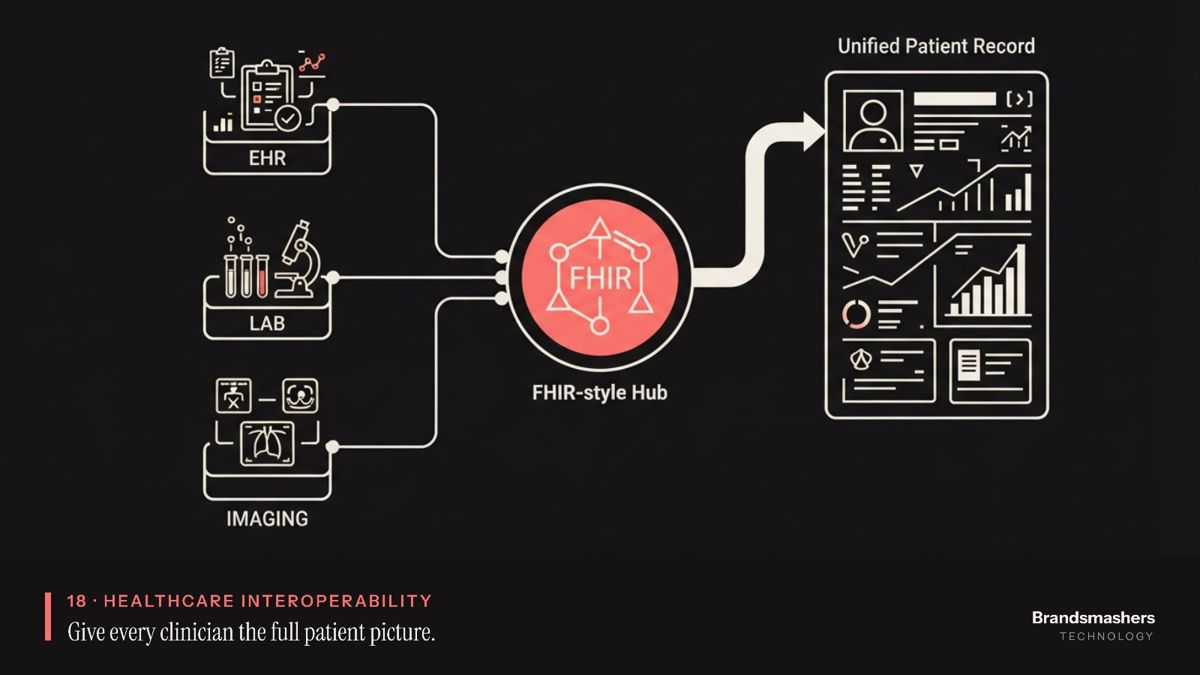
that connect multiple EHRs into one patient view.
Data mapping, terminology (code-set) mapping and patient matching
, with a record of every mapping decision.
Secure, auditable data exchange
with access controls, consent-aware filtering where required, and logging.
Ongoing support
for interfaces that cannot go down, including monitoring, alerting and on-call cover agreed with your team.
Who this is for.
Payers preparing the four CMS-0057-F APIs and unsure how to sequence the work.
Hospital networks with several EHRs and no single view of a patient.
Health-tech vendors whose customers keep asking for FHIR endpoints.
IT teams running a tangle of point-to-point HL7 v2 feeds that nobody fully owns.
Organisations facing an audit and needing logging, access control and monitoring around data exchange.
How we work.
We begin with an inventory. Every interface, what it carries, which system owns each end, and who gets called when it fails. Most organisations discover feeds nobody remembers. That list becomes the plan.
We then pick one high-value flow and build it end to end on a shared exchange layer: mapping, patient matching, validation, retry, audit. Each interface is tested against real message samples, with identifiers handled according to your policies. Existing feeds keep running during the work. We cut over one flow at a time, with a rollback path agreed in advance.
What you get.
An interface inventory with owners, volumes and risk ratings.
Working FHIR and HL7 v2 interfaces for the agreed flows, with automated tests.
A terminology and field mapping specification your clinical and IT teams have reviewed.
Monitoring and alerting for message failures, delays and queue growth.
Audit logs that show who accessed what and when.
Documentation and handover sessions, so your team can run what we build.
- Top 3% of applicants
- Start in 48–72 hours
- Dedicated account manager
- 100% replacement guarantee
Typical timeline.
Payer API work and multi-EHR work follow different shapes. We will estimate each separately after discovery.
- 01
Weeks 1 to 2
interface inventory, standards and version review, first flow chosen.
- 02
Weeks 3 to 6
exchange layer, mappings and patient matching built and tested on samples.
- 03
Weeks 7 to 10
integration with live systems in a test environment, security and audit controls, clinical review.
- 04
Weeks 11 to 14
pilot with real traffic, monitoring tuned, cutover plan agreed, then phased go-live.
Proof
add one real healthcare integration project here once approved.
No. Most organisations keep HL7 v2 for internal feeds and add FHIR for apps and regulated exchange. We build the bridge between them.
Related work and reading.
 Case studyConnecting three disconnected EHR systems into one patient viewRead the story
 Case studyBuilding an HL7/FHIR data exchange layer for a hospital networkRead the story
 ArticleWhy healthcare data still doesn't talk to itselfRead the article
 ArticleHL7 vs. FHIR: a plain-English guideRead the article
LET'S TALK. Start now.
Tell us what you're building. We'll come back with a plan and matched, pre-vetted engineers.
CONTACT