Food Processing Batch and Expiry Tracking Software in India
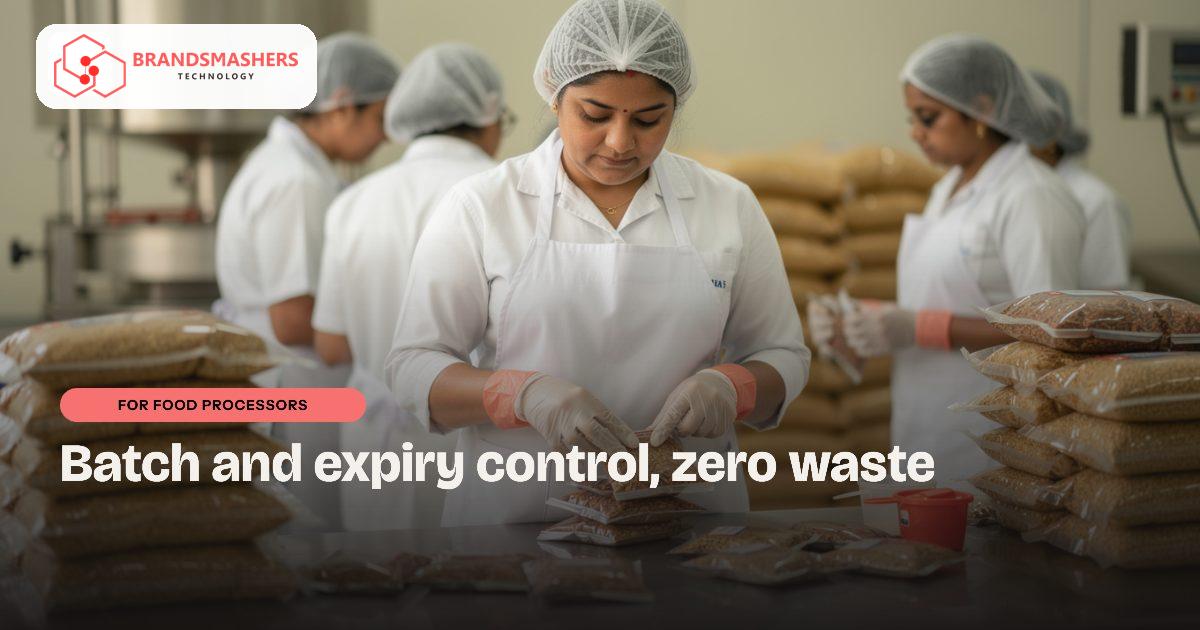
A retailer reports a problem with one lot. The team opens three registers to find the batch, its ingredients and every customer who received it. For food processors in Indore, Bhopal or Nagpur, this is what happens when batch numbers, expiry dates and licence records are kept in registers, and tracing one lot takes far too long. Brandsmashers Tech, based in Bhopal, builds fast, AI-assisted custom software for gaps like this. Here is how we would approach it for a food processor.
01.Who this is for
This is for food processors in India that turn raw material lots into packed goods and sell to retailers and other buyers. You have outgrown registers when tracing one complaint means opening several books to find the batch, its ingredients and every customer who received it, when stock near expiry is found too late, and when FSSAI records are pulled together in a hurry before an inspection. Yield and temperature figures that are written down but never compared are another sign the paper system has reached its limit.
02.Why lot tracing takes days instead of minutes
Most food processors do not lack effort. They lack one place where the facts live. So people fill the gap with calls, messages and memory, which works until volume grows or a key person is away. Off-the-shelf tools rarely fit because your process has its own steps and exceptions, and forcing it into a template brings the spreadsheets back.
03.What we build for a food unit
We start with the workflow that hurts most. For this business that usually means batch records linking raw material lots to finished goods, expiry tracking with first-expiry-first-out dispatch, a compliance log for the records your licence requires, and dispatch records that trace each lot to its customers. AI-assisted development lets you see a working version early and refine it with your team. Where you already run accounts software, we connect to it rather than replace it.

04.Where AI helps, and where it stops
The AI layer is modest and useful: anomaly alerts that flag unusual yield, temperature or expiry patterns for a supervisor to check. Alerts prompt a human check. Food safety decisions stay with your quality lead, and we build to the records your own procedures require. If your data is thin at the start, we begin with clean capture and add intelligence as records grow.
05.Built for India, not adapted to it
Indian food processors keep FSSAI licence and batch records that inspectors may ask to see. We structure the log so it is easy to produce, in rupees and with GST invoicing on dispatch; what the law requires of you is for your consultant to confirm. Madhya Pradesh has a strong food and agri base, and WhatsApp alerts to supervisors fit how teams already work.
06.How a first version comes together
For a food unit, the first version is usually built around tracing one lot both ways, back to raw materials and forward to customers.
- 01We walk the unit with your production and quality leads to see where raw material lots, batch numbers and expiry dates are written down today.
- 02We agree a first version that links raw material lots to finished goods and each finished lot to the customers who received it.
- 03Supervisors test entry on real batches, and we run a mock trace together to check that one lot can be followed quickly.
- 04First-expiry-first-out dispatch, the FSSAI compliance log your consultant confirms, and GST invoicing on dispatch are added next.
- 05Anomaly alerts for yield, temperature or expiry patterns are switched on later, sent on WhatsApp to the supervisor who checks them.
07.Questions buyers ask
- How does food processing batch tracking software in India speed up lot tracing?
- It links each raw material lot to the finished goods it went into, and each finished lot to the customers who received it. When a retailer reports a problem, your team searches one record instead of several registers. The trace runs both ways, so you can see the ingredients behind a batch and every dispatch that carried it.
- Will it keep our FSSAI records ready for an inspection?
- We structure the compliance log so the records your licence requires are easy to produce when an inspector asks. What the law requires of you is for your consultant to confirm, and we build the log around their list. The aim is that records are kept as work happens, rather than assembled in a rush.
- Can it manage first-expiry-first-out dispatch?
- Yes. Expiry tracking guides dispatch so the stock with the earliest expiry goes out first. Dispatch staff see which lot to pick, and the system records which lot went to which customer. That record is what makes a later trace quick, and it ties directly to GST invoicing on dispatch.
- Who decides what happens when an alert fires?
- Your quality lead does. Anomaly alerts flag unusual yield, temperature or expiry patterns for a supervisor to check, and they can arrive on WhatsApp. An alert prompts a human check and nothing more. Food safety decisions stay with your quality team, and the system simply records the check and its outcome.
Next step: Tell us the one process that costs food processors the most time today, and we will sketch what a first version could look like for your team in Indore. Contact Brandsmashers Tech
NEXT STEP
Need help with this?
KEEP READING