
One View Across Every Collection Centre: Lab Software for Indian Chains
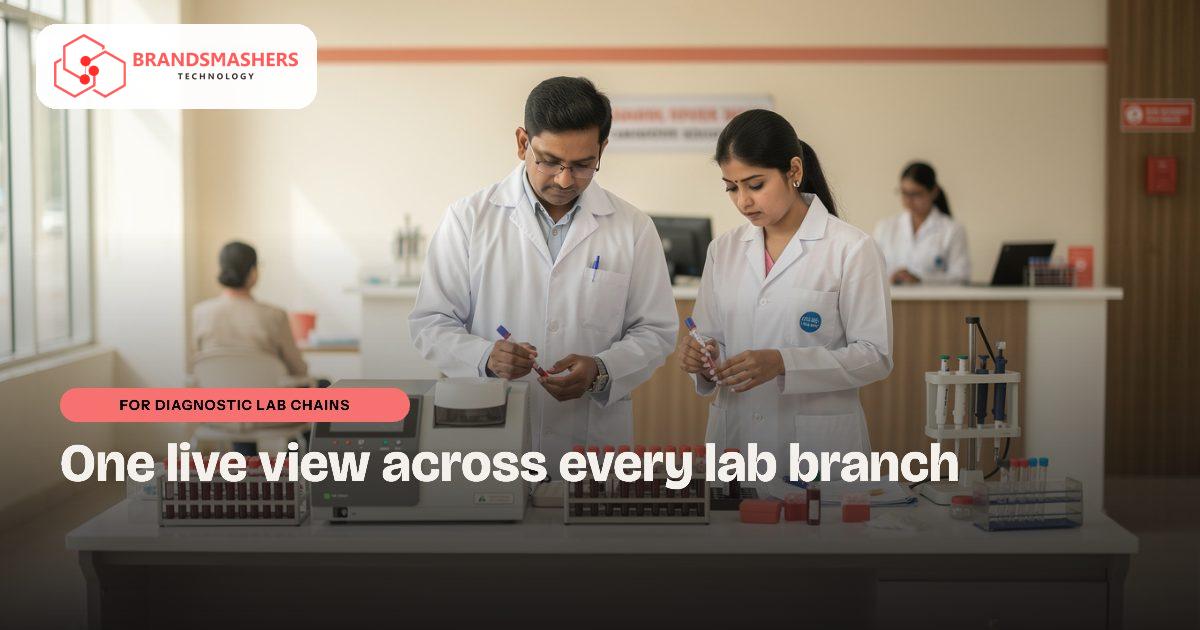
A lab chain grows by adding collection centres, and every new centre adds another place where a sample, a bill or a report can go missing. If your reports still travel as PDFs on personal phones and paper slips, you cannot see the whole chain from one screen. That is fixable without buying a bloated enterprise system.
01.Who this is for
This is for diagnostic lab chains in India that run a main processing lab with a ring of collection centres feeding it. You have outgrown registers when the front desk keeps a notebook of samples sent, the runner carries paper slips, and finished reports leave as PDFs from a technician's personal phone. Other signs are familiar: a patient calls twice about the same report, a centre's bills do not match what the lab received, and the owner learns about a lost sample only when the complaint arrives.
02.Where the work breaks today
India has more than 130,000 labs, and organised chains hold only about 20-25% of the market, according to the research we rely on. Most of the rest still run on registers and chat threads. For a chain in Bhopal, Indore or Nagpur, the real cost is not software licences. It is the hours spent chasing which centre has sent which sample, and answering patients who ask where their report is.
03.What we build
We build lab billing, sample tracking and report delivery on WhatsApp, with ABDM-ready records. Every build is custom to how you actually work, so we start by watching your counter, ward or desk for a day and mapping the real flow, not an imagined one. Our AI-assisted process lets a small team build quickly, so you see a working version early and shape it with your staff instead of reading a long specification.

04.Where AI helps
The AI layer is deliberately practical. For this business that means: abnormal-value alerts and plain-language report summaries. A person always reviews anything that matters, and the AI never takes the final decision. It is there to remove repetitive effort, not to replace your team’s judgement. We also keep the data yours: you own the system, the records and the code, and your WhatsApp numbers and templates stay under your control.
05.Fitting it to your clinic, your rules and your rupee budget
ABDM, the national digital health mission, is the dated trigger here: by 10 July 2026 about 5.33 lakh facilities were registered but only 2.72 lakh used ABDM-enabled software, and Madhya Pradesh has only about 20,000 facilities in the registry. Vendor estimates for custom builds in this space run roughly Rs 3-12 lakh, which we treat as a starting hypothesis, not a quote. Ask your compliance adviser what applies to you.
06.How a first version comes together
A first version for a lab chain is built around the journey of one sample, from the collection counter to the report in the patient's hands.
- 01We spend a day at a collection centre and at the main lab, noting how a sample is labelled, logged, billed and handed to the runner.
- 02Together we agree the smallest useful first version, usually lab billing and sample tracking from centre to lab, with report delivery on WhatsApp close behind.
- 03We build it and test it with your real front-desk staff, phlebotomists and technicians, using sample entries from an ordinary working day.
- 04We switch on one collection centre and the main lab first, fix what the staff point out, and then add the remaining centres one at a time.
- 05Once the core is in daily use, we add abnormal-value alerts and plain-language report summaries, with a pathologist reviewing what the AI flags.
07.Questions buyers ask
- What should diagnostic lab software in India handle for a multi-centre chain?
- It should give you one record per sample that every centre and the main lab can see. That means billing at the counter, a tracked handover to the lab, result entry and report delivery on WhatsApp. We also structure records to be ABDM-ready, so you are not rebuilding them later when digital health records become part of your routine.
- Can we move our existing patient and test data across?
- Yes, in most cases. We look at the registers, sheets and any old software exports you have, then move the records that are worth keeping into the new system. Where old data is messy, we agree with you what to clean, what to archive and what to leave behind, rather than importing problems.
- How is AI used on test results, and who checks it?
- AI is used only to flag values that look abnormal and to draft a plain-language summary of a report. It does not diagnose and it never sends anything on its own authority. A qualified person at your lab reviews the alerts and summaries before they reach a patient or a referring doctor.
- Who owns the system, the patient records and the code?
- You do. The system, the records and the source code belong to your business, and your WhatsApp numbers and message templates stay under your control. If you later decide to work with a different team, you keep everything you paid for and can hand it over without asking our permission.
Next step: Tell us how your team works today, and we will map a fixed-scope first version. We reply in English or Hindi, and we are happy to meet in Bhopal. Talk to Brandsmashers Tech
NEXT STEP
Need help with this?
KEEP READING
More from the blog.
- FOR POLYCLINICS
Retire the Appointment Register: Polyclinic Software That Fits Indian Clinics
READ ARTICLE - FOR POLYCLINICS

Appointments, Records and Billing in One System for UAE Polyclinics
READ ARTICLE - FOR SMALL HOSPITALS AND NURSING HOMES
OPD, IPD and Insurance Claims in One Place: A Lightweight HMS for Indian Nursing Homes
READ ARTICLE