Plastics Unit Machine Utilisation Software in the UAE
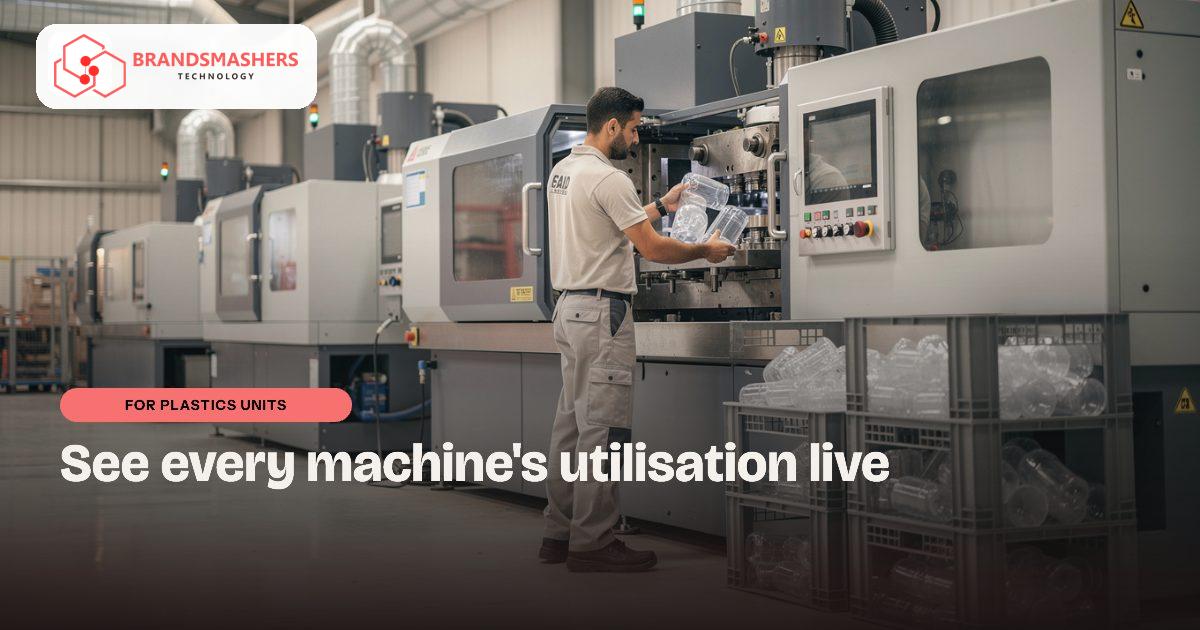
Machine 4 stood idle for part of a shift waiting for a mould change. The supervisor remembers it, the log does not, and the cost never reaches a report. For plastics units in Dubai, Sharjah or Abu Dhabi, this is what happens when you cannot see how long each machine really runs, stops or waits for a mould, so idle time hides in the day. Brandsmashers Tech, based in Bhopal, builds fast, AI-assisted custom software for gaps like this. Here is how we would approach it for a plastics unit.
01.Who this is for
This is for plastics and packaging-material units in Dubai, Sharjah or Abu Dhabi running moulding or extrusion lines with mixed-nationality shifts. The trouble shows when a machine stands waiting for a mould and the only record is a supervisor's memory. Stoppage notes are written in several languages or not at all. Job status between moulding and dispatch is checked by walking over. Management suspects idle time is costly but has no figures to point to, and the shift report says little about why a line stopped.
02.Why idle time is the biggest hidden cost
Most plastics units do not lack effort. They lack one place where the facts live. So people fill the gap with calls, messages and memory, which works until volume grows or a key person is away. Off-the-shelf tools rarely fit because your process has its own steps and exceptions, and forcing it into a template brings the spreadsheets back.
03.What we build for moulding and extrusion
We start with the workflow that hurts most. For this business that usually means a machine log with running, idle and changeover time, job tracking from order to moulding to dispatch, reason codes for every stoppage, captured in two taps, and utilisation views by machine, shift and product. AI-assisted development lets you see a working version early and refine it with your team. Where you already run accounts software, we connect to it rather than replace it. We keep screens simple, because a system nobody enters data into is worse than none.

04.Where AI helps, and where it stops
The AI layer is modest and useful: downtime prediction that learns from your own stoppage history and warns when a machine looks likely to stop. Predictions are only as good as the history, so we start with logging and add prediction once there is enough data to trust. If your data is thin at the start, we begin with clean capture and add intelligence as records grow.
05.Built for the UAE, not adapted to it
UAE plastics and packaging-material units often run mixed-nationality shifts, so screens work in English and Arabic with icons for speed. Dispatch and invoices are VAT-ready. We scope to the machines you run, and integration with machine controllers can come later if your equipment supports it.
06.How a first version comes together
A first version for a UAE plastics unit starts with logging that any operator can do quickly, whatever language they read.
- 01We go through a typical shift with your production manager by video, listing every reason a machine stops or waits.
- 02We agree a starting scope of a machine log with reason codes, using English and Arabic screens with icons for speed.
- 03Operators from your different shifts test it on the machines you run, and we adjust icons and wording until entry takes no thought.
- 04Job tracking from order to moulding to dispatch follows, with VAT-ready dispatch documents and invoices.
- 05Downtime prediction and, if your equipment supports it, integration with machine controllers can come later.
07.Questions buyers ask
- Can machine utilisation software for plastics units in the UAE work for operators who do not read English?
- Yes. Screens work in English and Arabic, and icons speed up entry for operators who prefer not to read long labels. Stoppage reasons are captured in two taps. We test with your own shifts and change any icon or label that causes hesitation, so the log fills itself in as part of the shift.
- Can it connect directly to our machine controllers?
- That can come later if your equipment supports it. We start with quick manual logging, which works on any machine and gives you useful utilisation figures from the start. Once the log is trusted and you know which machines matter most, controller integration can be looked at for equipment that allows it.
- Is the first version built for every machine on site?
- We scope to the machines you run and the problems that cost most. Often that means starting with the busiest machines and adding the rest once the team is comfortable. Where you already run accounts software, we connect to it rather than replacing it, so dispatch and invoicing stay joined up.
- How does the AI predict downtime?
- It learns from your own stoppage history and warns when a machine looks likely to stop. Predictions are only as good as that history, so we start with logging and add prediction once there is enough data to trust. Your supervisors decide whether to act on a warning, such as planning a mould change earlier.
Next step: Tell us the one process that costs plastics units the most time today, and we will sketch what a first version could look like for your team in Dubai. Contact Brandsmashers Tech
NEXT STEP
Need help with this?
KEEP READING