
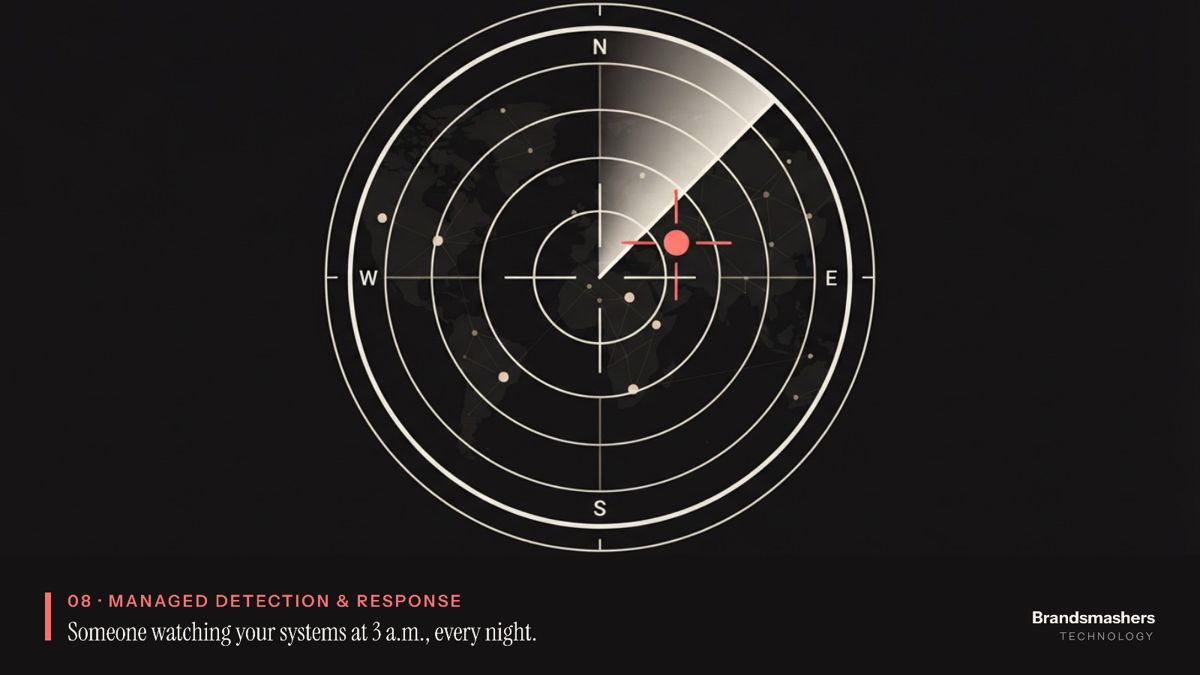
Someone watching your systems at 3 a.m., every night.
24/7 threat monitoring, investigation and response for companies without a full security operations team.
- 48–72 HOURS
- TOP 3% ENGINEERS
- 100% REPLACEMENT
Attackers do not work office hours. Many break in late on a Friday or during a holiday, because they know few people are watching. A small company cannot staff a round-the-clock security team, and tools alone do not answer alerts. An alert that nobody reads until Monday is a delay, not a defence. Managed detection and response (MDR) gives you trained analysts watching your systems and ready to act, without building a security operations centre of your own.
- 48–72hfrom first call to engineers in your standup
- Top 3%of applicants, vetted for the work
- 100%replacement guarantee on every hire
What we do.
Continuous monitoring
of endpoints, cloud, identity and network activity, so one stolen password or one odd process does not go unseen.
Threat investigation
by security analysts, not just automated alerts. An alert becomes a decision: real threat or false alarm.
Rapid response
isolate devices, disable accounts and block traffic, under playbooks you have approved in advance.
Monthly reporting
on incidents, trends and fixes, written so a non-specialist can follow it.
Detection engineering
we write and tune rules for how your business actually runs.
Help building your own detection capability
over time, with documentation and training.
Who this is for.
Mid-sized companies with an IT team but no security staff.
Businesses that bought security tools and have nobody to watch them.
Manufacturers and services firms with no after-hours cover.
Teams facing a customer or audit request for monitoring and incident response.
Leaders who want clear reporting on risk, not a stream of raw alerts.
What you get.
Monitoring across the sources we agree with you: endpoints, cloud, identity and network.
Analyst triage and investigation of alerts, with notes you can read.
Response playbooks for the incidents most likely to hit you.
Agreed escalation paths: who we call, when and what we need from you.
A monthly report covering incidents, trends and recommended fixes.
Detection rules and logs that stay yours.
Quarterly review of coverage and gaps.
- Top 3% of applicants
- Start in 48–72 hours
- Dedicated account manager
- 100% replacement guarantee
How we work.
We begin with a short onboarding. We list what you run, connect the data sources and learn what normal looks like. We then agree playbooks and escalation. In the first weeks we tune hard, because untuned monitoring floods people with noise.
When something is wrong, an analyst investigates, decides, and either acts under an agreed playbook or calls the named contact. Each incident ends with a short written summary. We test the response with simulated events, so you know it works before you need it.
Typical timeline.
Wider scope or more data sources will lengthen the first phase.
- 01
Weeks 1 to 2
scoping, access and connection of data sources. Escalation contacts agreed.
- 02
Weeks 2 to 4
baselining, rule tuning and response playbooks drafted and approved.
- 03
Weeks 4 to 6
monitoring live, simulated events to validate detection and response.
- 04
Month 2 onward
steady-state operation, first monthly report and regular reviews.
Proof
For a mid-market manufacturer, response time fell from about 4 hours to 15 minutes in tested scenarios, with after-hours cover in place. For a mid-market B2B services company with no security staff, 12 simulated high-risk events were detected during validation, with mean time to detect under 10 minutes in tests.
Only within what you approve in advance. You choose which actions we can take on our own, such as isolating a laptop, and which need a call first.
Related work and reading.
 Case studyCutting incident response time from hours to minutes for a manufacturerRead the story
 Case studyDeploying 24/7 threat monitoring for a client with no security teamRead the story
 ArticleMDR vs. traditional antivirus: why the old model is dyingRead the article
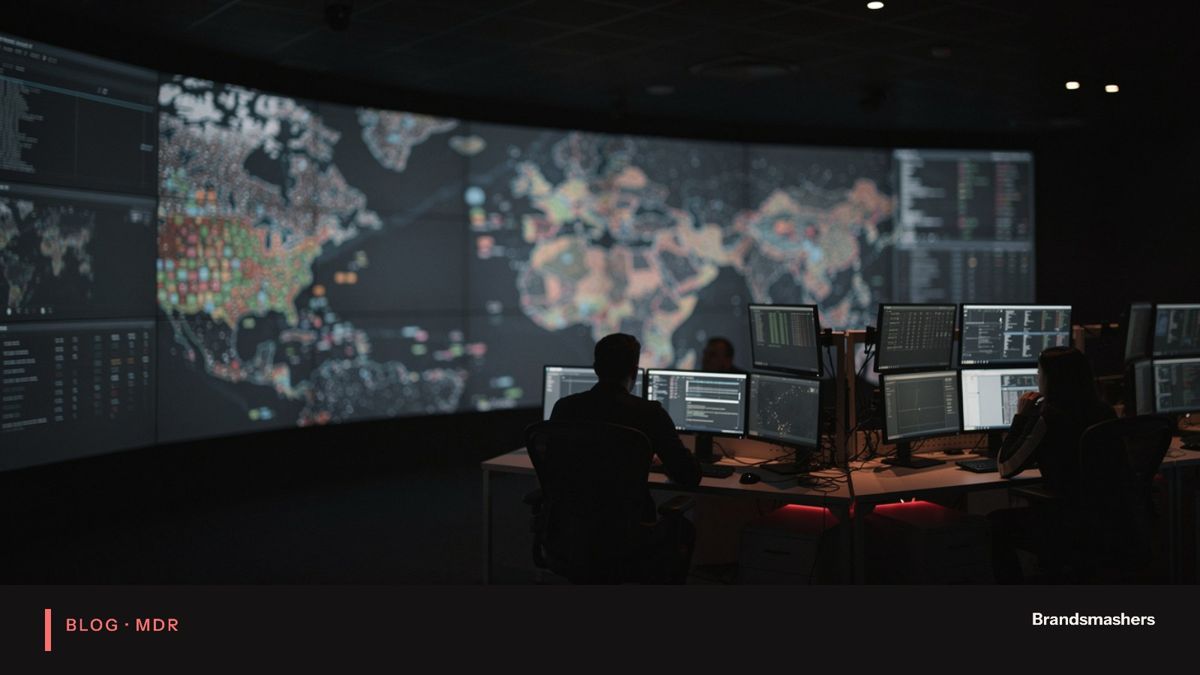 ArticleWhat to look for when choosing an MDR partnerRead the article
LET'S TALK. Start now.
Tell us what you're building. We'll come back with a plan and matched, pre-vetted engineers.
CONTACT